Why tune-ups matter more here
Summer monsoon storms drive walls of fine desert dust — haboobs — across the Valley. That dust packs into outdoor condenser coils and loads up air filters. A clogged coil cannot shed heat, so the compressor runs hotter and longer; a clogged filter starves airflow, which strains the blower motor. Systems that go into June already dirty are the ones that fail in July, when every technician in Phoenix is at their busiest.
Why AC failure in Phoenix is different
Phoenix averages 111 days a year at or above 100°F and about 21 days at or above 110°F (National Weather Service climate normals). Average daily highs run about 104°F in June, 106°F in July and 104°F in August, and the cooling season stretches across roughly eight to nine months of the year. Equipment here simply works more hours, in harsher heat, than almost anywhere else in the country — which is why systems wear out sooner and why a breakdown in July is a household emergency, not an inconvenience.
What a proper tune-up includes
- Coil cleaning — washing dust and debris out of the outdoor condenser coil, and checking the indoor coil's condition.
- Filter check or replacement — and honest advice on the right change interval for your home.
- Electrical checks — capacitor health and contactor condition, the two parts Phoenix heat wears out fastest.
- Drain line clearing — a blocked condensate drain can shut a system down or leak water into ceilings.
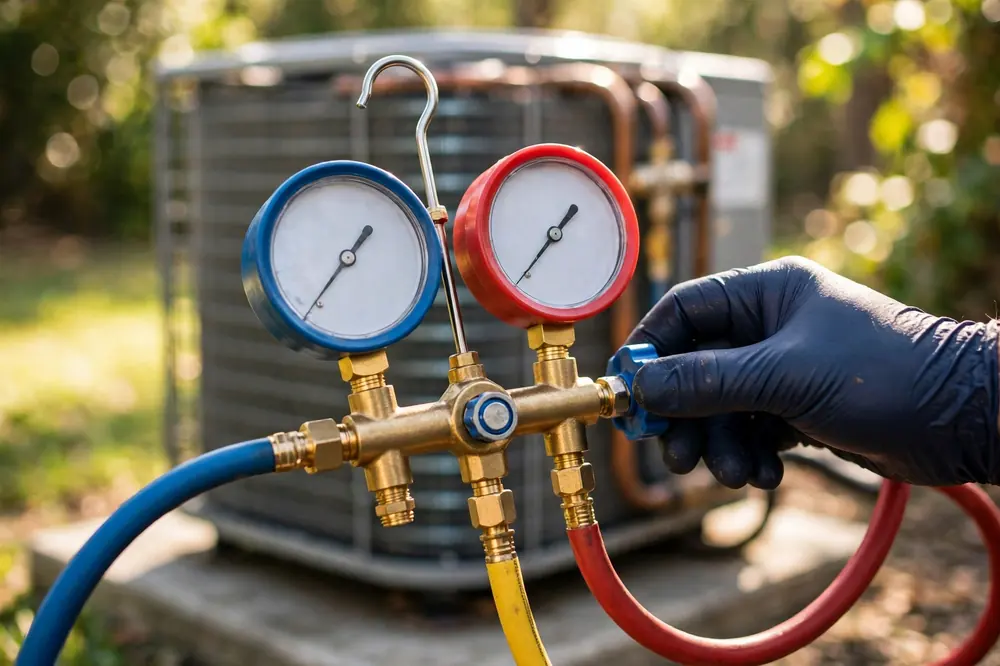
- Refrigerant and temperature checks — confirming the system is actually delivering the cooling it should, measured at the vents.
- Thermostat and airflow check — the small problems found before they become expensive ones.
When to book it
Spring — March through May — is the sensible window: the system is cleaned and checked before the 100-degree days stack up, and scheduling is easier than in peak season. A second filter check after the worst of the monsoon dust is worth it for homes near open desert or construction.
A tune-up cannot guarantee a system will not break down, and any service that promises that should be treated with suspicion. What it does is find the worn capacitor, the pitted contactor and the clogged coil while they are still small problems.
What happens when you call
Calling connects you with an independent Phoenix-area HVAC technician through our referral line. Here is the honest sequence:
- You describe the problem — no cooling, strange noise, a system that will not start, or a unit you think is at the end of its life.
- You are matched with an independent local technician who handles that kind of work in Phoenix.
- The technician inspects the system and quotes the work. Pricing is set by the technician, after seeing the equipment — never by this website.
- You decide. Nothing proceeds without your approval, and payment for work is arranged directly with the technician.
Before any work begins, ask to see the technician's Arizona ROC licence. Residential air conditioning work in Arizona falls under the ROC's R-39 (Air Conditioning and Refrigeration) classification, and you can verify a licence number on the Arizona Registrar of Contractors website.